Direction still matters
Premium does not erase a wrong thesis. Short options reshape directional exposure; they do not remove it.
 Stock MomDeep-dive library
OPTIONS SELLING • DEEP DIVE
We sell premium first, and buy it only with a plan. Understand what you collect, what you owe, and what can go wrong before you place the trade.
Know the shape. Every credit has a geometry—and a bill attached.
Choose a route
Start with the instrument, then the structures, then the systems that keep one trade from becoming the whole account.
Options, calls, puts, buying, selling, premium, strikes, and assignment.
6 lessons →02Cash-secured puts, covered calls, verticals, condors, and butterflies.
6 lessons →03Position size, portfolio heat, mechanical exits, rolling, and assignment.
6 lessons →Strategy library
Jump straight to any strategy lesson, from defined-risk verticals to calendars, diagonals, and undefined-risk premium sales.
Reference desk
Risk sizing lab
For a defined-risk credit spread, max loss is the spread width minus the net credit, multiplied by 100. This rounds down to the number of contracts that fits the chosen risk budget.
Illustration only. Commissions, slippage, assignment, and portfolio correlation are not included.
Premium does not erase a wrong thesis. Short options reshape directional exposure; they do not remove it.
Theta pays slowly when price behaves. Gamma can collect the tab quickly near expiration.
Rich premium can signal opportunity—or danger. Compare implied movement with what actually occurs.
The cleanest adjustment is opening small enough that no rescue is required.
Options involve substantial risk and are not suitable for every investor. Defined risk is still real risk; undefined-risk positions can lose more than the premium received and may lose more than the initial buying-power requirement. Verify contract specifications, assignment mechanics, taxes, and broker requirements before trading.
© 2026 Stock Mom. All rights reserved. Do not redistribute.
Practice lab
Change one assumption at a time and watch the obligation, expected range, expiration payoff, and account risk respond. The numbers are hypothetical so you can learn the mechanics without treating a model as a quote.
Use the stations in order for a guided practice session, or jump here from a lesson when you see a Practice this prompt. Each station isolates one idea; real option prices also reflect rates, dividends, liquidity, early exercise, and volatility skew.
Members only
Sign in to read the rest, or see how to get access.
Begin here
A plain-language foundation for a first options trade: what the contract controls, how calls differ from puts, what buying and selling really mean, and how expiration can turn a line on a screen into shares.
TL;DR: An option is a time-limited contract tied to an underlying asset. The buyer pays for a right; the seller receives that payment and accepts an obligation. A standard U.S. equity option usually controls 100 shares.
Buying an option does not automatically mean buying the stock. You are trading a contract whose value depends on an underlying such as a stock or ETF. Every contract answers five questions:
For a standard equity contract, a quoted premium of $2.40 means $240 changes hands: $2.40 × 100 shares. The buyer pays that debit; the seller receives that credit, before fees.
Members only
Sign in to read the rest, or see how to get access.
Chapter
Everything an options seller needs to know about volatility: what implied volatility measures, how to judge whether it is high or low, and how the Greeks — delta, theta, vega, gamma — shape every premium-selling trade.
TL;DR: Implied volatility (IV) is the market's forecast of future price movement, expressed as a single annualized number and baked into every option price. When you sell an option, you are selling that forecast — your edge is that reality usually comes in cheaper than the fear.
Think of every option price as two piles of money:
IV is quoted as an annualized expected move. A 40% IV on a $100 stock means the market expects roughly a $40 move over the next year — but you almost never think in years. Convert it to human scale:
| Horizon | Math | Expected move |
|---|---|---|
| Annual | 40% × $100 | ±$40.00 |
| Weekly | 40% ÷ √52 ≈ 5.55% | ±$5.55 |
| Daily | 40% ÷ √252 ≈ 2.52% | ±$2.52 |
That is a one-standard-deviation range — the stock lands inside it roughly 68% of the time. The √252 (trading days per year) and √52 (weeks per year) conversions are the seller's pocket math; memorize them.
Members only
Sign in to read the rest, or see how to get access.
Chapter
The six foundation trades of the premium seller: defined and undefined risk, each built on the same idea — collect credit up front, win when time passes, volatility falls, or the stock cooperates.
TL;DR: Sell an out-of-the-money put and keep strike × 100 in cash on the side. You get paid to be a willing buyer of a stock you'd happily own at a discount. Max profit is the premium; max loss is nearly the whole strike.
Every cash-secured put starts with a simple question: would I buy this stock at the strike price? If the honest answer is yes, selling a put lets you get paid while you wait for the opportunity. You sell someone else the right to sell you 100 shares at the strike, and you collect cash up front for taking that obligation. The trade is "cash-secured" because you reserve the full purchase amount (strike × 100) so assignment can never catch you short of funds.
Sellers run CSPs on stocks they are bullish-to-neutral on — names they'd own anyway. It is an income strategy on top of a stock-picking decision, not a substitute for one. The best CSP sellers could recite their watchlist without looking at a premium table.
Members only
Sign in to read the rest, or see how to get access.
Chapter
Undefined-risk, asymmetric, and capital-efficient structures: strangles, ratios, LEAPS, ZEBRAs, synthetic equivalents, and PMCCs. Some sell premium; others buy it deliberately to shape long exposure.
TL;DR: Sell an OTM put AND an OTM call, same expiration. Two premiums, one wide profit range — and undefined risk in both directions. A $20 move past a breakeven turns a $300 credit into a −$2,000 loss. Size like the tail risk it is.
A short strangle is the workhorse neutral premium trade: you sell an out-of-the-money put below the stock and an out-of-the-money call above it, same expiration. You're paid twice (put premium + call premium), and time decay works on both legs at once. The stock can drift, chop, or grind — as long as it stays between your strikes through expiration, you keep everything.
The price of that wide profit range is that both legs are naked. There is no long option anywhere in this trade. If the stock trends hard in either direction, losses have no cap — every dollar beyond a breakeven costs you $100 per strangle, for as far as the stock wants to go. This is the trade that separates sellers who respect tail risk from sellers who learn about it the expensive way.
Members only
Sign in to read the rest, or see how to get access.
Chapter
The foundation of everything an options seller does: two or more legs working as one trade, with risk defined before you click confirm.
TL;DR: A spread is two or more option positions opened together as a single trade. The long leg caps the short leg's risk, the net premium is the difference between legs, and your max loss is printed on the ticket before you enter.
A spread pairs a short option with a long option on the same stock. The two positions are called legs. Selling premium naked gives you maximum income but undefined risk; buying premium gives you defined risk but a decaying asset. A spread is the compromise that most working option sellers actually trade: you keep the short leg's income character while the long leg acts as built-in insurance.
Every spread has a net price. Add up everything you receive, subtract everything you pay. If you receive more than you pay, it's a net credit spread — cash lands in your account at entry and your job is to keep it. If you pay more, it's a net debit spread — cash leaves your account and your job is to grow it. That one number, credit or debit, decides the entire personality of the trade.
Three reasons sellers bother with two legs instead of one:
Members only
Sign in to read the rest, or see how to get access.
Chapter
The flagship income trade: two credit spreads, one on each side of the stock, a plateau of profit in the middle, and defined risk on both wings.
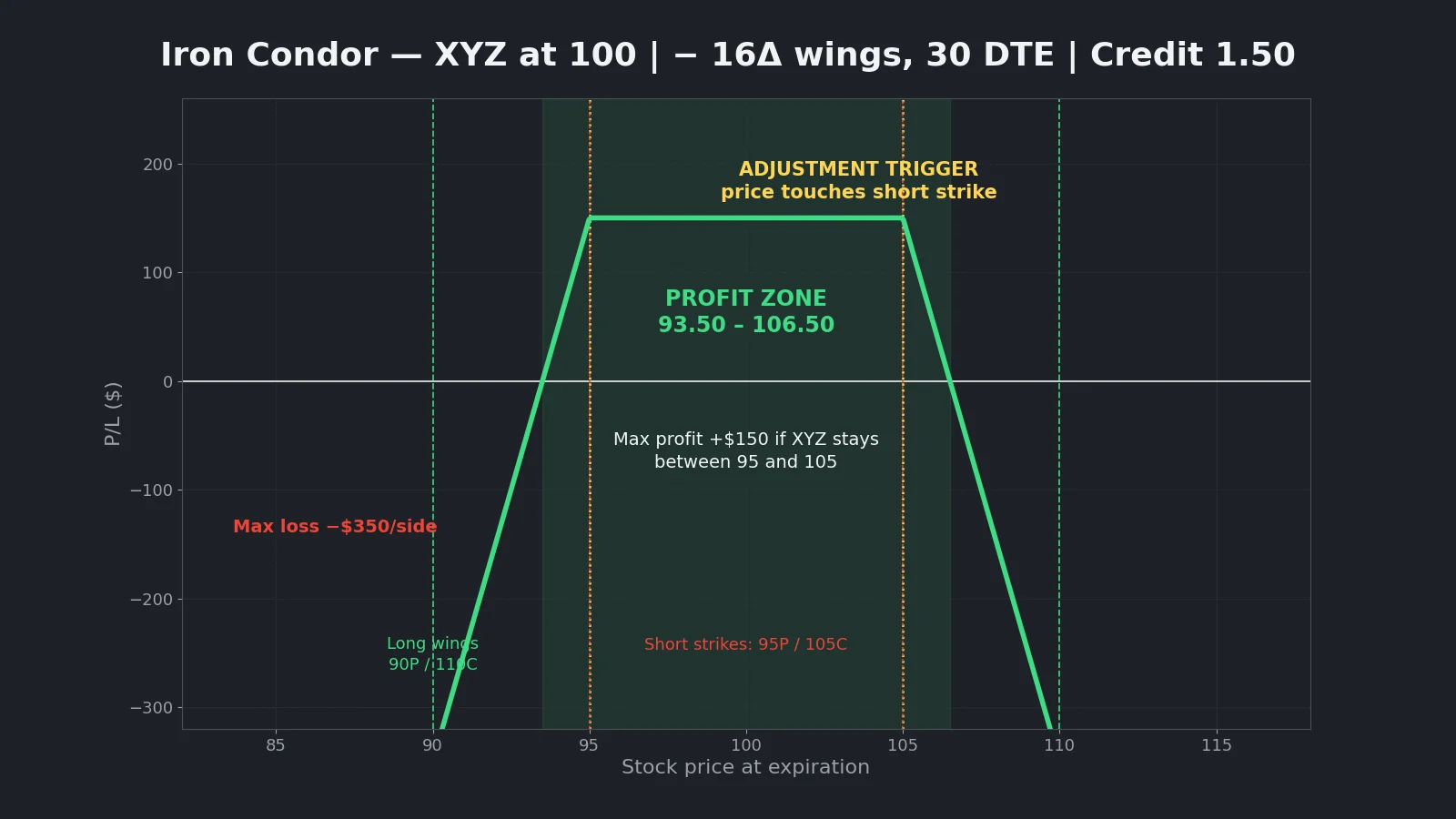
TL;DR: An iron condor sells a bull put spread below the stock and a bear call spread above it, collecting one net credit. You keep the credit if the stock stays between the short strikes; max loss is the wing width minus the credit on whichever side gets tested. Trade it with IV Rank ≥ 50, ~16-delta shorts, 30–45 DTE, 1–3% risk per trade, take profit at 50% of credit, and manage at 21 DTE.
An iron condor is two credit vertical spreads opened together — one on each side of the stock. Using XYZ at $100 with 30 days to expiration:
Four legs, one order, one net credit — say $1.50 ($150). The payoff looks like a plateau: flat maximum profit while XYZ stays between 95 and 105, sloping losses outside, hard-capped at the long wings. Only one side can lose at a time — the stock can't be above 105 and below 95 simultaneously. That's the structural beauty: you're only ever fighting one battle.
Three reasons the iron condor is the flagship income trade:
The honest trade-off: risk/reward is lopsided — risking $350 to make $150. The math works because you win often (70%+) and manage losers early. If you can't accept "many small wins, occasional managed loss," this isn't your trade.
Members only
Sign in to read the rest, or see how to get access.
Chapter
The simplest complete income system in options: get paid to wait for a stock you want, get paid to hold it, get paid to sell it — then do it again.
TL;DR: The wheel cycles through four phases on a stock you'd be happy to own: sell a cash-secured put → get assigned the shares → sell covered calls → get called away → repeat. Every phase collects premium. One rule governs everything: only wheel stocks you'd genuinely own for years, because the wheel can leave you holding shares.
The wheel is the simplest complete income system in options. You cycle between selling puts and selling calls on a stock you'd be happy to own, collecting premium at every step. The loop:
You're always getting paid: paid to wait (the put), paid to hold (the call). The stock is just the vehicle — the premium is the product.
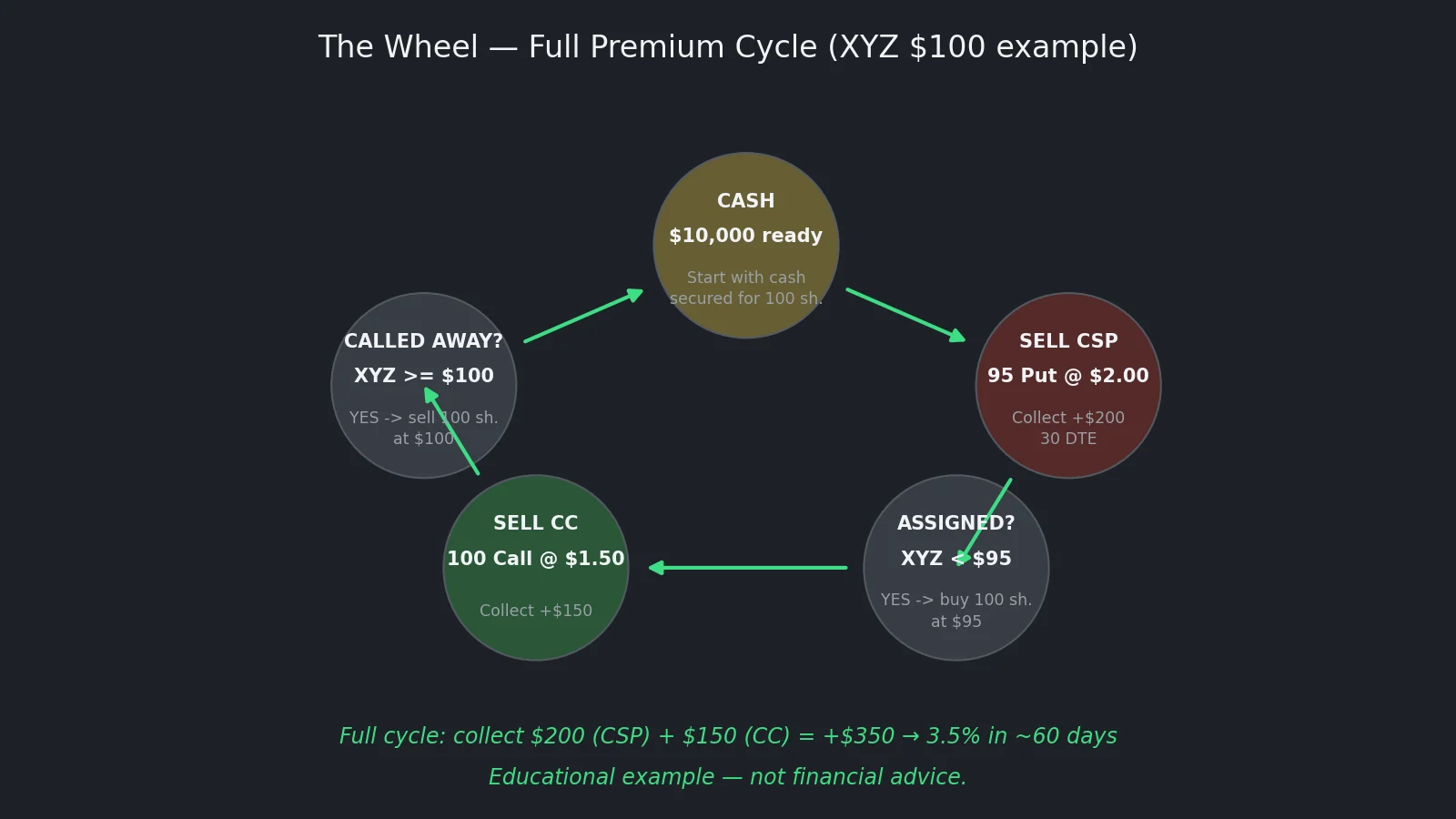
The one requirement: only wheel stocks you'd genuinely own for years. The wheel can leave you holding shares — make sure they're shares you want. This single rule prevents most wheel disasters before they start.
Members only
Sign in to read the rest, or see how to get access.
Chapter
Sizing, margin, heat, profit-taking, rolling, and assignment — the machinery that keeps a premium seller alive long enough for the edge to work.
TL;DR: Risk 1–5% of your account per trade, sized on max loss — never on premium received. Small size is what lets a 70% win rate survive the losing streaks statistics guarantee.
The #1 reason option sellers blow up isn't bad strategy selection — it's bad sizing. You can be right 80% of the time and still go broke if the 20% costs you too much. As a seller, the premium you collect is your maximum profit, but your risk is often 5–10x that premium. Sizing by premium ("it's only a $200 credit, I'll do 10 contracts") is how a $2,000 premium turns into a $20,000 loss.
Beginners should use 1–2% per trade. Experienced sellers with a demonstrated edge can go up to 5% — never more on a single position.
Members only
Sign in to read the rest, or see how to get access.
Chapter
The edge is thin and discipline is what keeps it: judging trades by process, taming loss aversion, killing FOMO and revenge trades, and building the journal-and-review habit that compounds.
TL;DR: A good trade can lose and a bad trade can win. Judge every trade by decision quality — P/L is a sample size of one, process is what compounds.
Key takeaway: Your only job on any given day is to run the process. The market handles the outcomes. Scoreboard: "I executed 4 trades, all within plan" beats "I made $500 today."
Sell a 45 DTE iron condor — high IV rank, 70% probability of profit, perfect 2% sizing. A surprise headline gaps the market and you take a max loss. That was a good trade. You'd take it again 100 times. Now the reverse: you YOLO a naked weekly call because a friend texted you a ticker, and it doubles. That was a bad trade — you got paid for recklessness, and the market just taught you the wrong lesson. Until you truly believe a good trade can lose and a bad trade can win, your results will control your emotions instead of your process controlling your results.
Members only
Sign in to read the rest, or see how to get access.
Chapter
Step-by-step walkthroughs for trading options on tastytrade, thinkorswim, Schwab, Interactive Brokers, Fidelity, and Robinhood — plus options approval levels and how to read an option chain like someone who gets paid by it.
TL;DR: tastytrade was built for premium sellers — IV Rank on the quote page, a chain with table and curve views, and a strategy builder for spreads. Open a margin account, get spread approval, configure seller columns once, and always price spread orders at the mid.
tastytrade's entire design assumes you sell premium mechanically: high IVR → sell, manage at 50% of max profit, redeploy. But the account type you open decides what you're allowed to sell:
| Account type | What sellers can do |
|---|---|
| Individual margin | Standard choice: defined-risk spreads, and naked options with higher approval |
| Joint / entity | Same trading permissions, different ownership structure |
| IRA (Traditional / Roth / SEP) | Defined-risk spreads and covered calls — no naked options, no margin borrowing; spreads must be fully cash-secured |
Cash vs. margin: open a margin account. A cash account can't comfortably hold the short leg of most strategies, and defined-risk spreads in a margin account use far less buying power than the same trade in cash. Pick "Margin" at account opening, then request options approval (see Options Approval Levels).
Menu paths shift with app updates — the descriptions below are directional. If a label moved, search the setting name in the app's help or settings search.
Members only
Sign in to read the rest, or see how to get access.
Premium toolkit
Three calculators for the decisions that cost sellers the most: whether a spread pays enough for its risk, whether a roll is worth it, and what to do with an iron condor right now. Each one applies the rules from the course, so you can check a real trade against them in a few seconds.
Enter prices per share, the way your broker shows them (a $1.50 credit means $150 per contract). The tools use expiration math and rules of thumb. They don't know about your broker's fees, early assignment or what the market will do next, and they aren't a recommendation to place any trade.
Members only
Sign in to read the rest, or see how to get access.
Premium toolkit
Every rule from the course, organized the way you use it: one page per strategy, plus checklists for the moments that decide most trades. Tick the boxes as you go (they're saved on this device), or print a page and keep it next to your screen.
These pages summarize the course; each links back to the full lesson. They're educational, not a recommendation to place any trade.
Members only
Sign in to read the rest, or see how to get access.